Oh, I think that you can do that! Especially now that you are starting to add some long stuff in 
I’m less confident if I’m honest.
Got a while to get to long distance fitness after my calf niggle
Was meant to be Monday, but end of June now
3 Likes
Come on @funkster you were my inspiration for sub 3… it’s those low HR sessions that did it. Even at the end, I could have plugged on at 4:30/km for a lot more time because I was conditioned for running at that “easy” intensity. It really made a big difference.
1 Like
Got 8 weeks to go, so we’ll see how we go
16 weeks to Adelaide marathon, never done one but ran 3:19 at IM (in magic shoes 
 )
)
Tempted, and want to give one a go one day soon but unsure I have enough run base to get to where I want to be to go sub 3. Also had typical injuries in past trying to increase load too fast compared to what others would get away with.
Half-marathon on same day and think will probably go for the half and try run well. PB is 1:25 so would want to try break 1:20.
2 Likes
@Chriswim dude, even with a semi/ok build up i’d say you won’t see too much difficulty in hitting a sub 80. Someone that’s run a 3.20 in an IM and gone under or near to 17 on a 5km (can’t remember your last result) then it’s not too much of a stretch. Just need to build the speed endurance. I personally found that the targets beyond 80 start to get really tough (for the level runner i am).
Similarly a sub 3 is well in your capability, but will depend on your ability to last the training block and then get the pacing right.
You should deffo go for one of them.
If that’s true then a sub 80 HM and sub 3 M should be more than doable
I can’t break 18 for 5km
17:34 5k, but you’re right I would fancy my chances of under 17:15 (have done 4:59 1 mile at peak). I agree I’d have a good chance of 80, maybe a chance of 78 but every minute becomes huge difference there! The thought of holding 3:40s/km is crazy.
Agree that in theory there’s a sub 3 there at some point, probably a realistic 2:50-2:55 but I don’t think I can get myself there in 4 months. I think all training would have to be easy volume building else get injured from having intensity and volume.
So leaning towards the half 
Don’t want to be too negative either, but I did ~4 runs in the Nike shoes and do believe they made a huge difference for me, massive PBS way beyond what deemed possible from training. Coming from someone who thinks they saw next to zero improvement from the magic swim suits, so perhaps not just purely placebo.
You’re heaps faster than me but that seems like a hell of a lot of fluid for a marathon. My last one had 144mtrs vert and I had a swig of water every other lap. (it was 11 laps) and 4 gels, which I carried in a number belt.
Were you wearing a vest? I can’t quite tell from your report, as you mention changing bottles but also having a feed set up?
I think with a relatively low elevation like 175 and your fitness, you’d knock a flatter marathon out of the park but I’m surprised you needed to drink that much. Didn’t you feel bloated?
I set 2 aid stations which I passed twice each. Started out not carrying any fluid. At first aid station at 7km I picked up a running belt with a 350ml bottle. I then passed it again at 14km and picked up a second 350ml bottle. 21km passed another aid station had a cup of water and swapped belt for one with 2 250ml bottles. 31km passed final aid station, had more water and swapped belt for a 350ml bottle.
I was taking frequent sips of fluid, definitely not sloshing around. I lost just over 1min swapping bottles. I had 1 gel at km 7 another at km14, forgot to grab one at km 21, had a gel at km 31 and final gel at km36.
Around 235g carbs in total, which is about right. I had approx 2l fluid, my sweat rate is just over 1l per hour so was slightly dehydrated but probably not enough to impact performance significantly. Probably a little low on electrolytes.
Ah i see, sounds like a good set up. When i did the marathon at Goodwood, we had our bottles on the chicane wall and I would take a drink from mine every other lap.
Trouble was, each drink I took, I kept running and then put the bottle down, so near the end of the marathon I was running out of wall. 
2 Likes
There’s actually a train of thought, which i think may have come out of @ChristofSchwiening camp that the dehydration effect doesn’t negatively impact performance, but enhances it due to you getting lighter, as long as you’ve trained your body in the runup. Somethign around becoming more efficient at sweating effectively i.e. retaining the electrolyte balance and sweating a more ‘pure’ water solution to continue with the cooling function whilst maintaining balance. I did a lot of heated, over dressed fasted runs when i tried the big mileage, no speed stuff in the run up to my 2017 London attempt. My buddy, who Christof knows (Ryan Snell) tried this a lot.
Tim Noakes talks about this in Waterlogged
In support of what i stated (from a patchy memory) or opposing?
In support I assume, although I’ve not read waterlogged itself, but Noakes is very vocal on the idea that drinks companies have hugely oversold the idea that mild dehydration affects performance. Think he’s as a bit of a Marmite personality by many (like his student Ross tucker), but his work on exercise induced hyponatremia from people over consuming water has saved lives.
1 Like
Was trying to find the passage in the book.
Basically they tested the top runners at distance races and found they were the most dehydrated
1 Like
There are quite a few studies that have estimated the fluid consumption of high level marathon runners during competitions - as well as doing weight measurements. They do seem to lose a lot of weight (5% is not uncommon, some more than that). There is a lot of water osmotically stored in muscle with glycogen and that gets liberated into the circulatory system during hard efforts. That water can replace the water lost as sweat, so weight loss does not mean dehydration in the sense that most people think of it. Weight loss can be beneficial if it does not compromise the blood flow back to the heart (venous pressure). Venous pressure is maintained by venoconstriction which needs to be sustained and gradually increased as the marathon progresses - and it is one of the trainable systems. The sweat glands and their ability to produce a more dilute sweat is also critical. The more dilute the sweat the more water can be drawn osmotically from the very large intracellular water stores which would not otherwise be available. The sweat glands can also be trained. The training pressures that train both sweat glands and the venoconstriction also produce a larger adrenal gland which enhances catecholamine secretion (adrenaline) as well as increasing plasma volume expansion which ultimately leads to more red blood cells and a higher stroke volume of the heart. It is probably why the Tanda equation works - at least for relative training effectiveness - since it captures the stresses that lead to multiple useful adaptations.
I haven’t eaten or drunk in a marathon for quite a few years - except when it was not a maximal effort and there was no point in optimizing speed. I think in Frankfurt I lost 3.15kg - if I remember correctly. My first attempt at running a marathon with no food or drink was also my first sub-3 when my ‘fruit jellies’ got buried under everyone else’s junk and so I just ran.
There is, of course, a big difference between a skinny person hitting out a sub 2:45 in reasonable weather conditions and a slightly overweight person running a 4:30 marathon in the heat. Although, in both cases water is probably best used externally to ‘cut-out’ the middleman. If you can cool the skin, which also reduces sweating, you can save water and salt. You also avoid having to absorb the water in your guts, which requires blood flow.
Anyway, just my views - other views are available!
9 Likes
7 weeks until the MK marathon
Calf is almost back to 100%
So decided as the weather was nice to hit some marathon pace work as I’ve not done any for almost 8 weeks.
Set out for between 10-13 miles at target pace of 6:51 and had a loop in mind to balance out any winds
First mile has a small rise over the railway so will always be a few seconds slower
6:37
Bugger.
Slow down.
Mile 2…6:36
Bollocks.
Ok, let’s try and settle in and see what happens.
By this point the sun was out and it was getting warm, which is all fine except the sweat is pouring out of me and I’ve only had about 250ml of water this morning
Decided 10 miles was the goal as each mile was still around the mid/high 6:30s
Pushed the last mile and done.
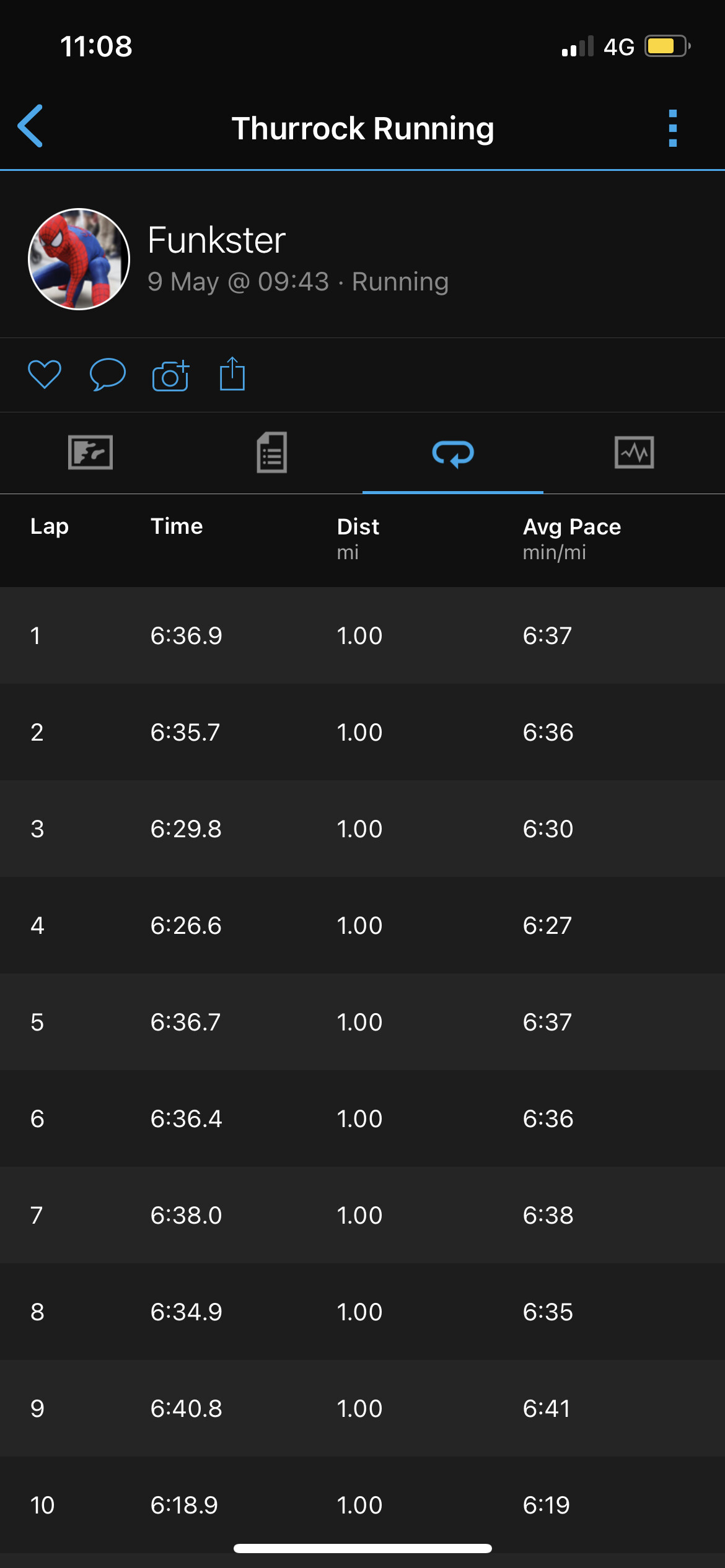
This really highlights the issue I have with pace.
Whatever I start at is what I will go at until the point that I break.
I need to dial in just under 3hr pace so I’m nicely aerobic and don’t have to think.
Obviously the next 3 weeks are going to involve pushing the mileage up and we might do something stupid like a 100 mile week at half term
11 Likes
Are you still doing Frankfurt?
I’d be utterly poo-pah’d after a stand-alone marathon, I “suppose” seven weeks might be enough?
Set your watch as a target for pace and HR to HM - can do all that from the watch in under a minute.
Leave your house
Start walking
Programme the watch
Limber up
Start slowly jogging
Get up to pace
Lock it in 
2 Likes
Yep.
It will also be school holidays for the month leading up to it, so plenty of training/recovery to be had.
I’d be doing 20+ mile runs in the lead up to an IM anyway.
The marathon will only be 20-25 seconds a mile quicker than my current long run pace
I had the average pace showing on the Garmin today.
Didn’t help.
Even when I thought I slowing the pace was the same
2 Likes