sure it was just Swim Smooth
I downloaded one of their plans and it was just as hammerer says. For a session you might need a full set of toys, do seemingly unrelated drills and maybe only use each toy once for a short distance. I prefer a session to be simple and focused. I’m sure Paul is excellent as a coach poolside. I was in W.A. last year and in Perth for a few days but not enough time to make it for a session but hopefully next time.
1 Like
I meant the Ironman/Oly session plans which are over complex, the actual SS book is informative and well written, good diagrams great explanations and basically idiot proof.  I did like their DVD’s which are better as you can see what is going on and try to replicate the drills. It a good compromise i suppose but the complexity is an issue with anything generic as its being too much to too many people and this doesn’t work. You see it this lot with AOS, they buy books, DVD’s do their 1hr £80 SwimforCash, try to change 100 things at once but my 10 year old son swims faster than them. This is by no means meant as disrespectful but you can learn a lot by how learn to swim programmes are run and the novice club squads. Its not because he/they doing 15hrs a week or massive miles either. Up until October 1st he swam 2 hrs a week (now 3 times & 3.5hrs) but it was all strokes and largely technique focused and with a coach next to you at all times. So Id always say rather than looking at the next best “system” or reading all these books just get to a pool in a masters / tri club where the coaches are knowledgeable about the swim. They are not only finding faults, we can all do that, but can find ways to actually communicate ways to fix them also which is the key skill and why i usually suggest swim teachers rather than tri coaches to novices and also why I’ve done a teaching course. A book cant tell you what you are doing and how YOU can fix it.
I’m being overly harsh as its a business that appears successful. My gripe isn’t with swimsmooth really but the industry in general where everyone is trying to sell a “system” or the next quickest way to become Phelps when it’s so far from the truth.
But none of this takes away from anyone’s coaching ability. Key to good coaching is what your communication, questioning and observation skills are like which has nothing to do with the way you design sessions.
3 Likes
He focused a lot on this in the interview. He said how most of the skillset in coaching is understanding the individual and ensuring you are communicating effectively with them.
Moving away from the typical triathlete who over analyses everything and tries to change too much at once was exactly what he was recommending. He even gave the same kind of advice as I think you have about using a tempo training to progressively raise stroke count over time, and how large scale changes would almost certainly fail.
The big question I have is your point about using swim teachers rather than tri coaches. I certainly get the principle. However his case study example was Harry Wiltshire, but he made similar references to the Brownlee’s, none of whom have typically good swim strokes. Maybe I’m misinterpreting, but he seemed to be saying most swim coaches want to coach a particular style of swimming, whereas his view is that in triathlon you just need to find something that’s effective for that athlete. Being “textbook” was a false aim.
I can conceptually empathise with that mindset. Coming to swimming in my 30’s means I’m kind of at the point of trying to just get the most out of me that I can in a short space of time. I’m no longer the supple sponge that most children are in terms of learning new skills, and adapting holistically, and I don’t have the years available in terms of performance to commit to a multi-year programme that might result in some backwards steps in the interim.
The above sounds defeatist, and if I was just trying to swim to my potential then I may see things differently, as technique gains would massively outweigh any fitness losses through age given the current level of my swimming. But the same is not true (in my mind at least) of my bike and run. And I therefore see it as a reluctant compromise to have to try and get what I can out of my swimming before those other things begin to tail off
1 Like
This is a common held opinion of a number of tri coaches who are trying to make out they are someway better than swim coaches. Swim coaches dont understand open water, swim coaches are set in their ways, swim coaches coach the wrong hand entry (another of Pauls). Simon Ward and a few of his cult commented similar in the week on his FB page until i showed them video evidence that in fact the swim coaches were shortening strokes before the latest “celebrity TriSwim coach” said something and its Tri coaches that talk of brushing the leg etc. I also use a well known example in Adam Peaty to dispel that. Watch his BS compared to say Kitujima. I’ve done coaching courses in tri and swim and swim teaching, and both teach “a perfect way” to swim but all are very clear that you coach the individual.
1 Like
To be fair, he clearly wasn’t talking about all swim coaches. He mentioned Adam Peaty as well as a prime example of how a shorter stroke than “traditional” is showing to be advantageous. He also cited numerous medal winning swimmers that use a much higher stroke rate than the rest of the field - and these will have been coached in the solely swim world.
Much of the criticism was levelled at the “yellow book” (is that Total Immersion?). I’ve not read it, but what I took from his interview was that previously that book had encouraged as long a stroke as possible, to the point that the “over-glider” has become a mainstream problem in self-coached athletes.
1 Like
Saying all that I do think there is a core old school still around in swimming though (and cycling) that havent been challenged and havent educated themselves continually over the years and still quoting science from the 70’s, but most that have been through coach ed in the last 15 years is definitely more of the open minded continuous development mindset. As with everything there are outliers, lots in tri that are very much “I know everything” of the Dunning Kruger theory
arr yes yellow book, in his time on TT he had many a swim biff with TI_Ian (RIP) . TI again has a lot of good stuff in it, Its being willing and able to take the good and ignore the bad rather than dismissing everything. A short but boring history lesson, Doc Councilman is the famous scientist who realised that swim propulsion was directly tied to drag and looked into the flight of bird, planes, allsorts. He was the first coach to come at swimming in a scientific way. He was the guy that first developed “sculling” for the freestyle stroke (The S pull). Maglischo is a more modern swim coach and his first book basically developed Councilmans ideas, but over the years he realised that much of the science, whilst correct was applied incorrectly and had the knowledge and confidence to say, I WAS WRONG. If you want a weight training session or a swimming tome then swim fastest is a cracking book. Its like the swim coaches bible. A lot of it is on other strokes, starts and turns etc, but so much science. It’s very big, and heavy
HELL YEAH!!!
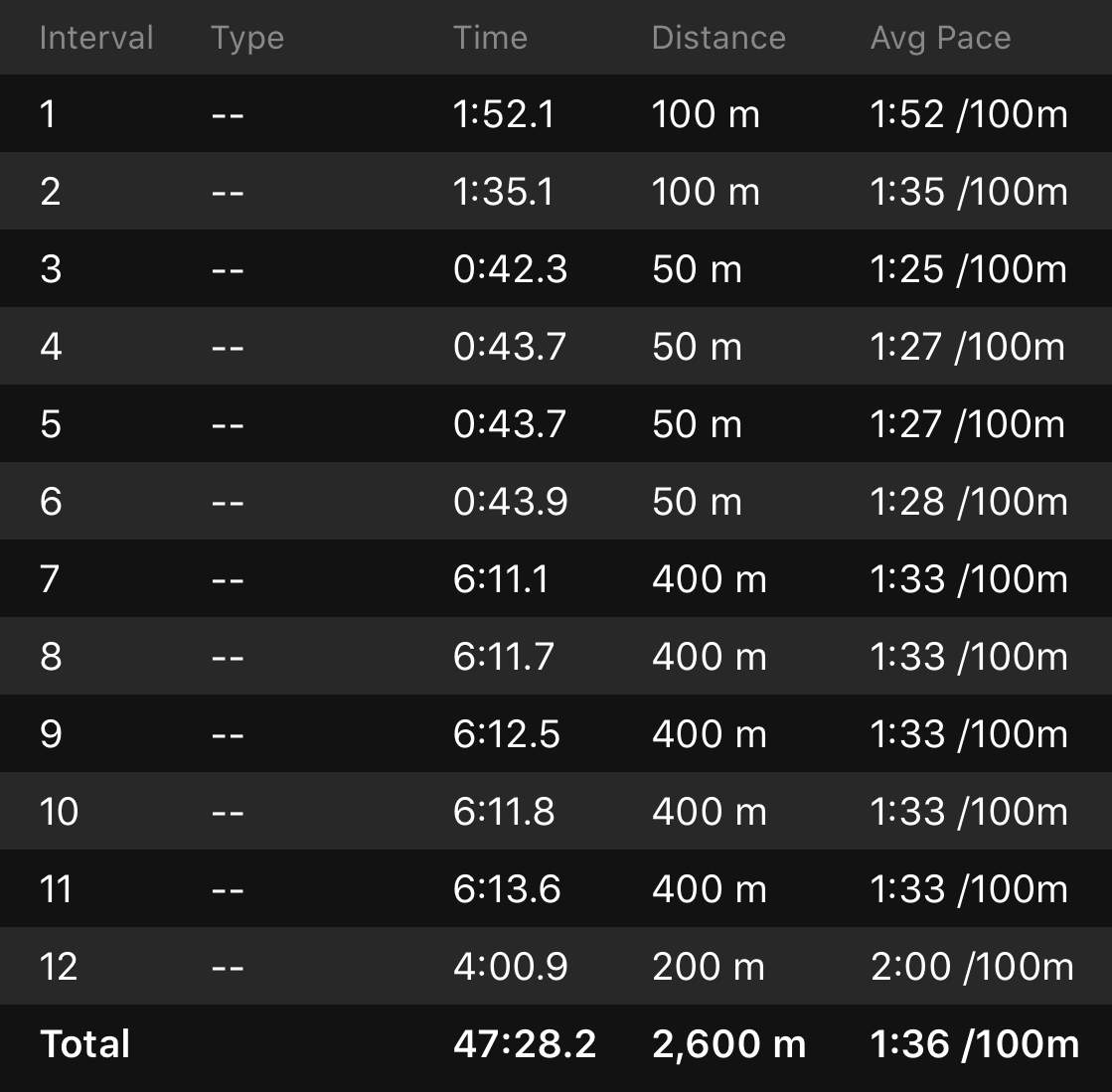
The 74km I’ve swam in the past in the past 54 days seems to be working 

CSS Test at the start was 6:04 and 2:52, giving 1:36/100m
Following the advice of @Jorgan, I did a longer interval set this morning, main part was 5*400m off 40s RI in 6:11, 6:11, 6:12, 6:11, 6:13.
Annoyed they’re not all bang on, but pleased with how far my pacing has come on in just eight weeks.
Following that, I’ll probably start doing my CSS/intervals sets as:
20 x 100m in Week1
10 x 200m in Week2
7 x 300m in Week3
5 x 400m in Week4
Now, I think I need to carve out a good recovery block to perform a rested CSS test.
4 Likes
Those 400 reps are really close; probably just a slower turn or two that would cause that difference.
I’m pretty sure the pouch on my jammers is causing unnecessary drag! They must be over a year old now, and that panel is getting rather baggy. Shame as the rest of the fabric is holding-up really well. Zone 3 MFX ones; got them using a Z3 voucher I won.
Yeah, @chriswim said not to get too hung up on the seconds here or there over the course of some intervals.
One of those ear bleeper things might help - but I find it hard enough counting to 16 without a beeping going off in my ear
The turns this morning were quite “lazy” and the effort was only mod, not mod-hard, so I reckon there are a few seconds for the turns if I give it some welly!
Yep I’d say that was essentially perfect at our level. 1 second variance over 372s.
Obviously one session doesn’t mean it’s finished so something to keep practicing every session, but the next step if wanted to further improve even pacing would be looking to make sure swimming evenly throughout the same 400m hitting 1:33 for each 100m. Rather than going out in 1:30, then swimming 1:35s through the middle and having a fast finish.
2 Likes
Ooh. Now you’re talking 
How can we get kurtosis into this, too?
Also, i think it records each lap in the back ground
Yeah I thought someone might be geeky enough to calculate standard deviation etc. But if we say it’s somewhere close to doing 5 bike intervals within 0.5W (0.2%) without looking at computer during the interval. Obviously different to compare effort and times, but it puts it in some context!
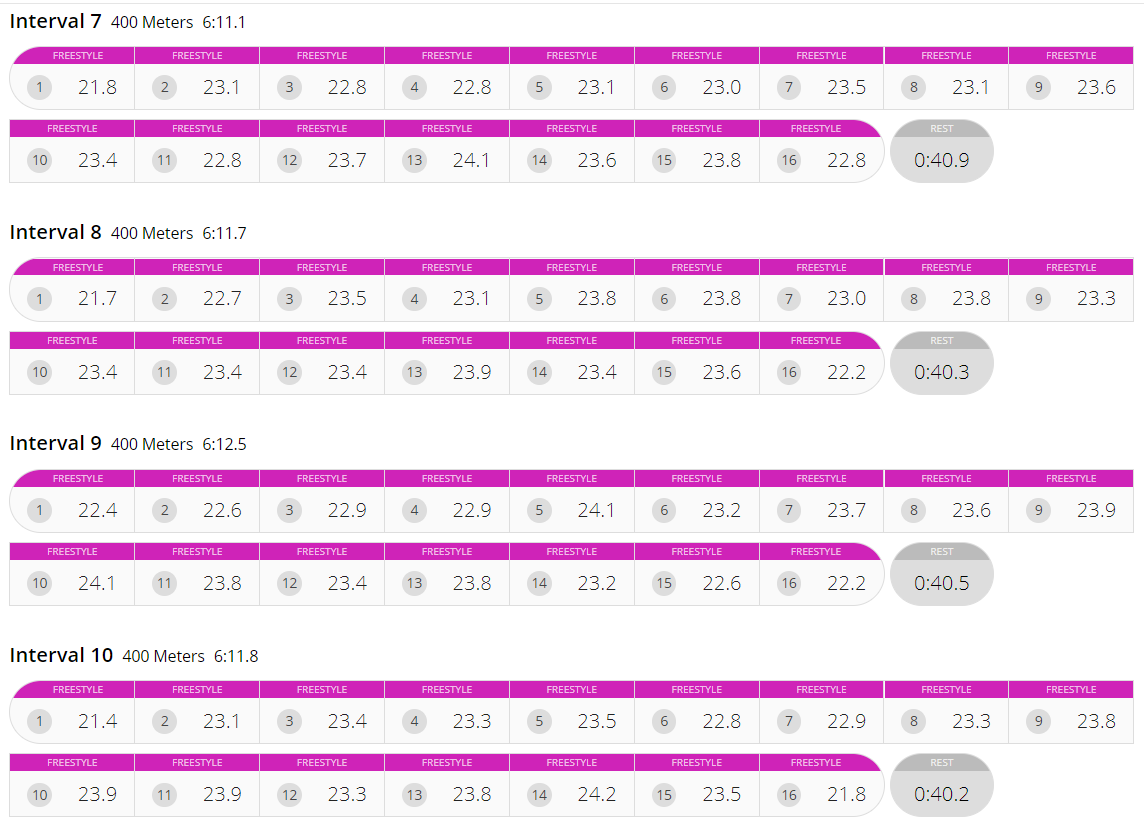
I wouldn’t trust a watch enough to be accurate knowing when you finished each length. As your splits show they’re all over the place which is mor likely the watch.
When self coached then just a quick snatched look at clock at halfway occasionally (so as not to disrupt actual swim) just to check would be better.
Ok gents.
So far there’s been some great information posted. I’ve started following GTN ( which I didn’t even know existed ) and they have some good instructional videos.
My question is, as a 2.10/100m swimmer ( and thats being generous ) and in the spirit of not changing 100 things at once, where do I start?
If I have to pick a couple of drills to work on, what would you suggest?
My kick is clearly an issue ( given that when I kick with a board I sometimes go backwards ) and I maybe gliding.
Do I just stick to trying to get a good turnover ( not gliding ) and keeping position in the water or would you suggest a more structured approach.
I notice that there is alot of discussion about stroke rate on here. Is there a magic number I should aim for?
I realise thats asking alot, but again, just a point in the right direction would be gratefully recieved.
Get someone to record you doing even one length, post it up.
Otherwise, swim more often 
Longer swim last night with 4 x 250 (just kick for final 50) then 3 x 400 with 40s RI
The 400’s were 6:46, 6:52, 6:48 these are significantly quicker than I have done before so really pleased. I am still no where near doing a sub 6 400, but at least I am on the correct side of 7 mins
2 Likes