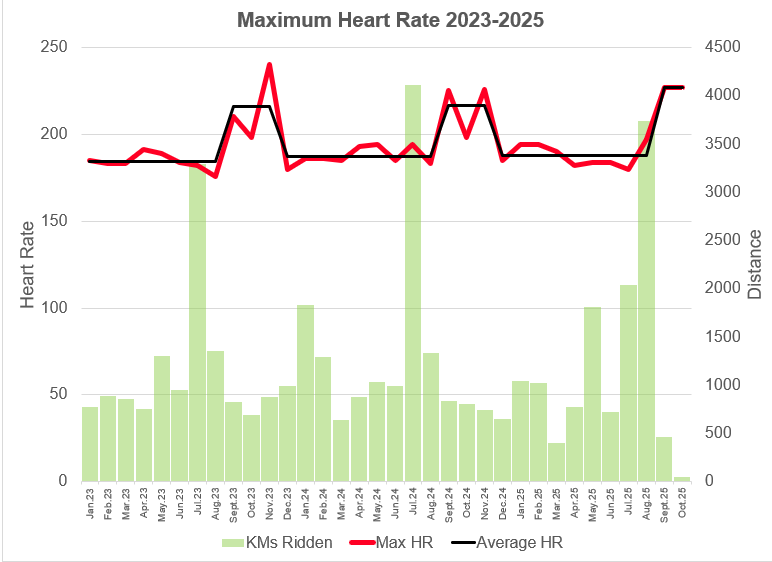
When I do TCR my Max HR for the following 3 months is around 20% higher than normal. the chart shows my My HR by month for the past 3 years and the distance I have ridden each month. It is pretty clear where TCR rides are. I have no feelings that anything is unusual, its only when I check my data that I see the big spikes in HR. Should I be worried?
4 Likes
I did post about this semi recently as I had similar issues, pretty sure I spoke to you about it as well. My HR was quite a bit higher than what I would have expected for the effort level I was putting out. I also didn’t rest enough post TCR. But it took about 3+ months to normalise. I did see a sports cardiologist who said its was normal and from my limited memory he said during sustained endurance activities your system moves into a high HR low pressure state. He had done some research on it. Anyway my advice would be take it easier post TCR and take more rest and recovery even if you feel absolutely fine, I did! Doing an IM post TCR isn’t ideal. I would avoid high HR inducing activities. I don’t think your at risk but you are delaying the recovery phase essentially.
3 Likes
That’s quite a spike, but you’d be very fatigued and borderline overtrained? Also would get a fitness boost from all the exercise at what I’m guessing is a steady pace?
The fact it returns is probably good.
Have you considered getting one of the advanced HR straps? Forgotten its name but a lad I know was told to get one after he had AF by the cardiologist. He wasn’t just an exerciser, been a very good athlete over the years.
3 Likes
The Frontier X2 is the only HR strap that does a continuous ECG, however, it costs £450. I now have a Fenix 8 and use the ECG app pretty often, I used it just after my ZRL race last night, where my HR spiked to 227 bpm - nothing is abnormal. Looking back at my Zwift race, my HR spiked during the first 5 mins, where I was desperately trying to hang onto a pack that was too fast for me. After 5 mins my HR came back down to around 165bpm, slightly below threshold, which felt about right. I think that the only advantage of a continuous ECG would be to measure my heart during these peaks to determine if there is any AFIB - however, I suspect that this is not the case. Maybe next time I do a Zwift race, when my HR peaks I could take an ECG reading on my watch
1 Like
The frontier is the one he got, can’t remember if he bought it privately or got it via the NHS.
But a bit pricey.
Obviously not definitive but it sounds reassuring that the HR matched effort and your perceived performance, and a quick check on the fenix ECG.
Very normal for HR to be unusual several months after such a big effort, these events have deep fatigue with autonomic dysfunction.
If it’s purely high HR with extreme effort and not a symptom issue then very unlikely paroxysmal AF/other tachyarrythmia.
3 Likes
That was also my thought, internet, even a forum as good as this is not the right place for a medical diagnosis. If there were any symptoms I think I would be more concerned and looking for advice. The fact this seems to happen on my previous 2 TCRs would also suggest that it’s deep fatigue related.
Other differences post TCR:
HRV was 65-75 now 45-55
FTP was 315 now 290
Resting HR is 40-45 and unchanged
Did a Marathon Yesterday, 3:19, which is pretty slow, my HR for first 45 mins, around 10k was 170-180bpm, after that it settle back to a much more normal 155-160. With all the wearables people have now, this would make a fascinating study about the impact on the heart / respiratory system following ulta events
8 Likes
Was HR from wrist or chest strap? If it was wrist based it may have locked on to your cadence rather than your actual HR at the start and then sorted itself out later.
2 Likes
Chest
1 Like