Also finally got some assiomas. Fat load of good they’ll do when I lack any motivation now though and cba with the turbo
1 Like
Felt this was the best place to follow up on this line of conversation on the Zwift thread. I was doing some further thinking about this last night and would be interested in others thoughts.
I totally get that an effort that is really spikey will not be representative of a steady state effort. But I thought that largely, it was the other way around? The spikey power profile will actually result in a lower AP than steady state? That’s the whole point of NP, right, and the fact that any bursts above threshold will have a large detrimental effect and hence the ^2 power in the formula?
In this particular case, I also had a power drop out. Looking at the detailed power file, it lasted 8-9 seconds, and in AP terms that could be quite impactful. Looking at the before/after power numbers, and adding those back in (I wasn’t coasting), I’d actually get a further 1.6w increase in AP for that 20 min best had the dropout not occurred and the power actually output been fully captured.
Then, in terms of “spikiness”, I had a VI for the 20mins of 1.01. And for the whole ride, Zwift Power has me at 25+ minutes with AP of 272w and NP of 273w. So whilst this wasnt steady state, it hardly seems like the kind of crit race where you’re either full gas, or off the power entirely.
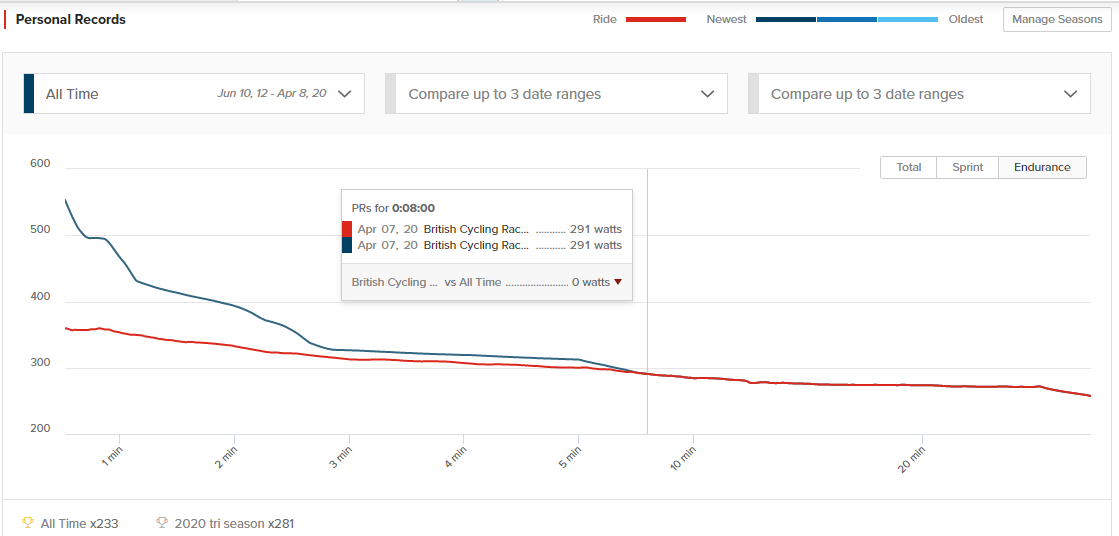
I set power curve pb’s all the way from 8 minutes to 25 minutes, and there was only a drop of 19w throughout those durations.
Lastly, you do have the challenge that I went into this 25 minute race “rested”, in so far as I hadnt done the standard 5min clearing effort immediately prior, so I can see there would be some anaerobic contribution to these numbers that a formal 20min test would often try and eliminate. That said, I did a separate ramp test 6 hours before, where i also set a lifetime best, so my legs were certainly not entirely rested and had done a chunk of work at higher power numbers (for me) … I set a lifetime best 5min power for example.
So, my question is, is the suggested zwift and trainingpeaks increase in FTP valid? Should I go with my ramp test result from yesterday of 253w, or take the ego massage of the 260/261w FTP (notified by TP and zwift respectively)?
Ultimately I know both a ramp test and a 20 minute test are simply attempts at approximations, so neither likely truly reflect my ability to hold steady state power for roughly 60 minutes, but from a subsequent training perspective, do people feel I should go with the lower or higher number?
The ramp test is the like for like comparison, although I was far from properly rested going into it, whereas the zwift race number is obviously the number the ego would like best. Ultimately, it’s only 7 or 8 watts, which is only a little over the error tolerance on my P2M anyway, so I’m probably splitting hairs! There’s a chunk of general power related testing questions embedded in this however.
This is where my thoughts were leading me to. A few Watts here and there, certainly in a training environment is not going to make a huge amount of difference. Personally I’d take the higher value, you may have an inadvertent increase in training effect by working that tiny bit harder. It’s not big enough to ruin your sessions if it is over estimated. But equally, don’t stress if you’re a couple of Watts off target when you are training.
I’d be more inclined to go with the lower if you were looking to calculate a race pace from the numbers. As those few Watts could be the straw that break your run in a race. But for training, I’d say crack on.
3 Likes
That’s quite a neat mindset to adopt, both now and for the future.
Probably supporting bespokes original messaging, I would normally base a 70.3 or full IM race strategy off training anyway, and efforts equivalent to what I want to do in the race itself. I’d never just do a test a week out and go, “right, 80% of that number is my HIM bike split power”.
So as you say, in training, a few watts here and there is unlikely to be a total deal breaker.
1 Like
This is a more relevant conversation than under normal times.
Due to the lockdown, many of us are doing a lot more indoor training than we normally would do. To make matters even more complicated, many of us are doing more racing on Zwift, rather than using a structured program like Trainer Road. As a result, we are seeing FTP increases in a slightly unstructured manner.
Wuhan is just coming out of lockdown after 74 day. We joke about it, however, it is very feasible that post 10 week lockdown, some people will be much stronger cyclists (whether they have the bike handling to match is questionable).
If your primary riding is racing on Zwift, I am not sure that knowing your FTP today is that important. But it will be important to know your FTP before you go back to structured training again.
If you’ve just discovered great gains from unstructured training where you don’t need to know your FTP, given t difficulty in obtaining an FTP, why would you return to it?
1 Like
I like that thought process. I let Training Peaks update my FTP automatically, however, I have not changed my FTP on Garmin (I don’t use my Garmin when riding on Zwift, so it is not picking up new FTP). So when I look at IF on my head unit, it is based on a slightly lower FTP.
1 Like
Because when I race on a Triathlon, I use IF as my main metric. IF is based on FTP
If I race on Zwift, Its based on RPE. Maybe in the future I will be more confident racing in the real world based on RPE
I’m still doing a structured Trainerroad plan. I’m just supplementing what would normally be harder runs and swims, with some extra indoor cycling via the occasional zwift race/ride.
So FTP is still important (for me) for those structured sessions.
Would it not make sense to use the TrainerRoad test result to set the TrainerRoad workout targets? It might not be a true reflection of your 60min power, but it is the TrainerRoad protocol so should fit their sessions appropriately.
Anyone got one of these? I’m currently in lockdown boredom shopping mode, looking at new bikes. Trying to work out what I can concede or gain within my price range.
Wondering if dropping from, say, ultegra to 105 would be worth it if I could drop a single arm 4iiii power crank in at £218.
I’m likely to commute on the bike, and probs do more zwifty stuff. Building to the odd tri over the next two years. Bike will likely only be an endurance/sportive type bike within my price range. Its primary function would be a commuter, so makes sense really.
I think DCR generally rates them. That’s a pretty compelling price, accepting the limitations of left only. I wouldn’t worry about 105 v ultegra. Certainly better than virtual power I would say.
1 Like
Not sure where to post this, so admin feel free to move if you think elsewhere is appropriate.
I have a Kinetic smart trainer. It gives me a power output reading. Judging by the reviews this is pretty accurate.
My question is, the power output versus the speed in Km/h seems off. ( again, this is reviewed as being accurate)
My average output for an interval session was 190w. This gave an average speed of 24km/h ( 15mph ish ) My top power for the session was 260w. This returned 31km/h ( 19.5 mph ish)
Does anyone here cycle around this speed or power output that can roughly say yes or no as to these numbers.
I realise there are a lot of variables but on my CX bike commute I average more that 24km/h and certainly don’t feel like I’m putting out 190w.
Hope that makes sense. Cheers
A fluid trainer like that has meaningless speed data. My old dumb turbo was reasonable in terms of a stable power curve (I tested it on TT1.0 when I got my first power meter) but the rear wheel speed was always pitifully low.
Ultimately, indoor training is all about power. I have never paid a single bit of attention to speed or distance indoors, other than right now due to joining on zwift. If you are doing 190w, then whether that is on the flat, downhill, uphill, into a headwind, on a smooth road or rough one, etc, will all impact speed in real life.
I know I’ve not really answered the question you posed, but I’m mainly suggesting you just don’t worry about it.
1 Like
I’ve got a KK road machine and find it’s not far away from my true speed on the road.
Apologies for the crappy pictures but these illustrate it.
The road one is TT bike Vs Road on a virtually flat (ever so slightly downhill with minor undulations) 2km stretch.
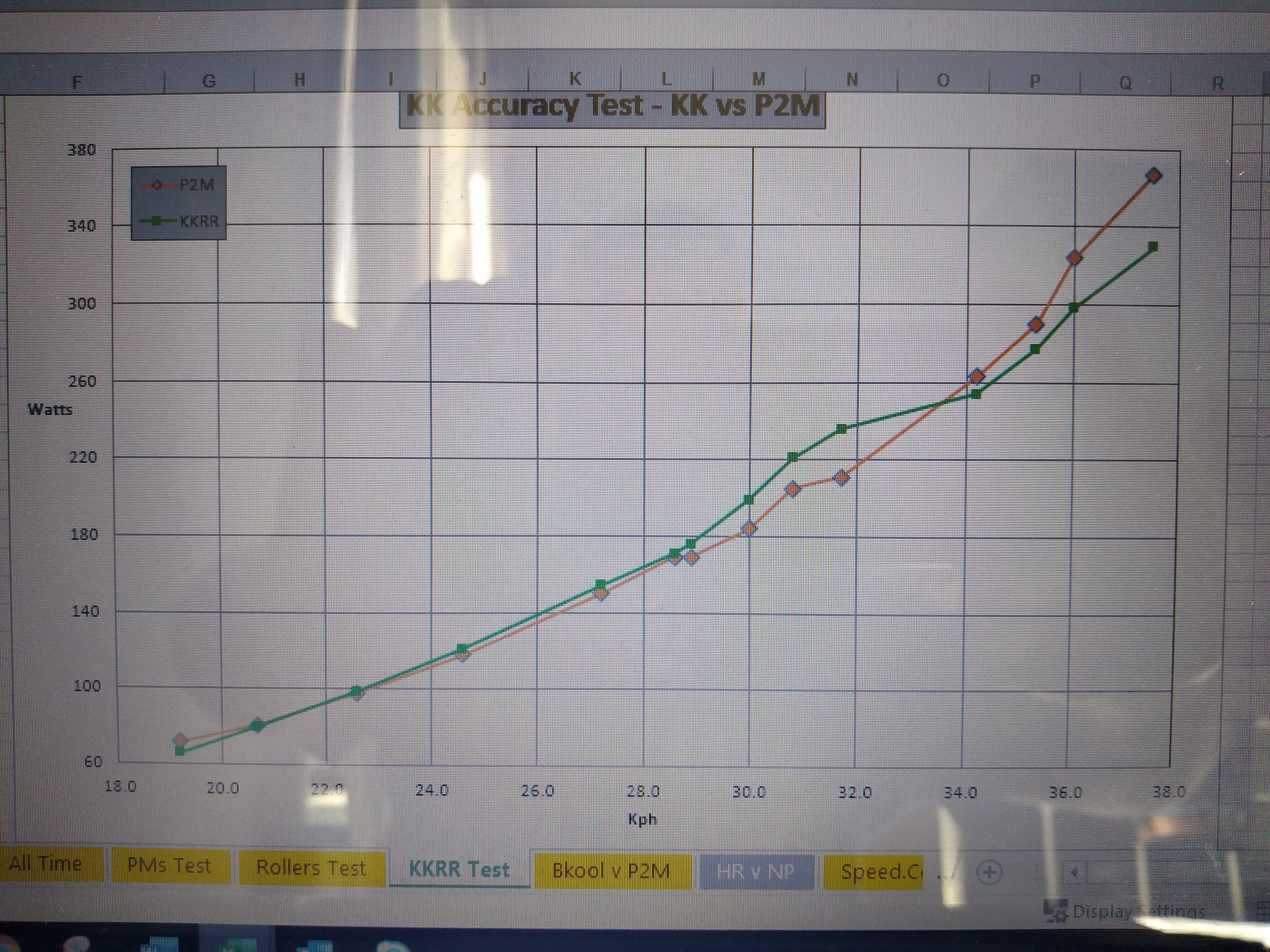
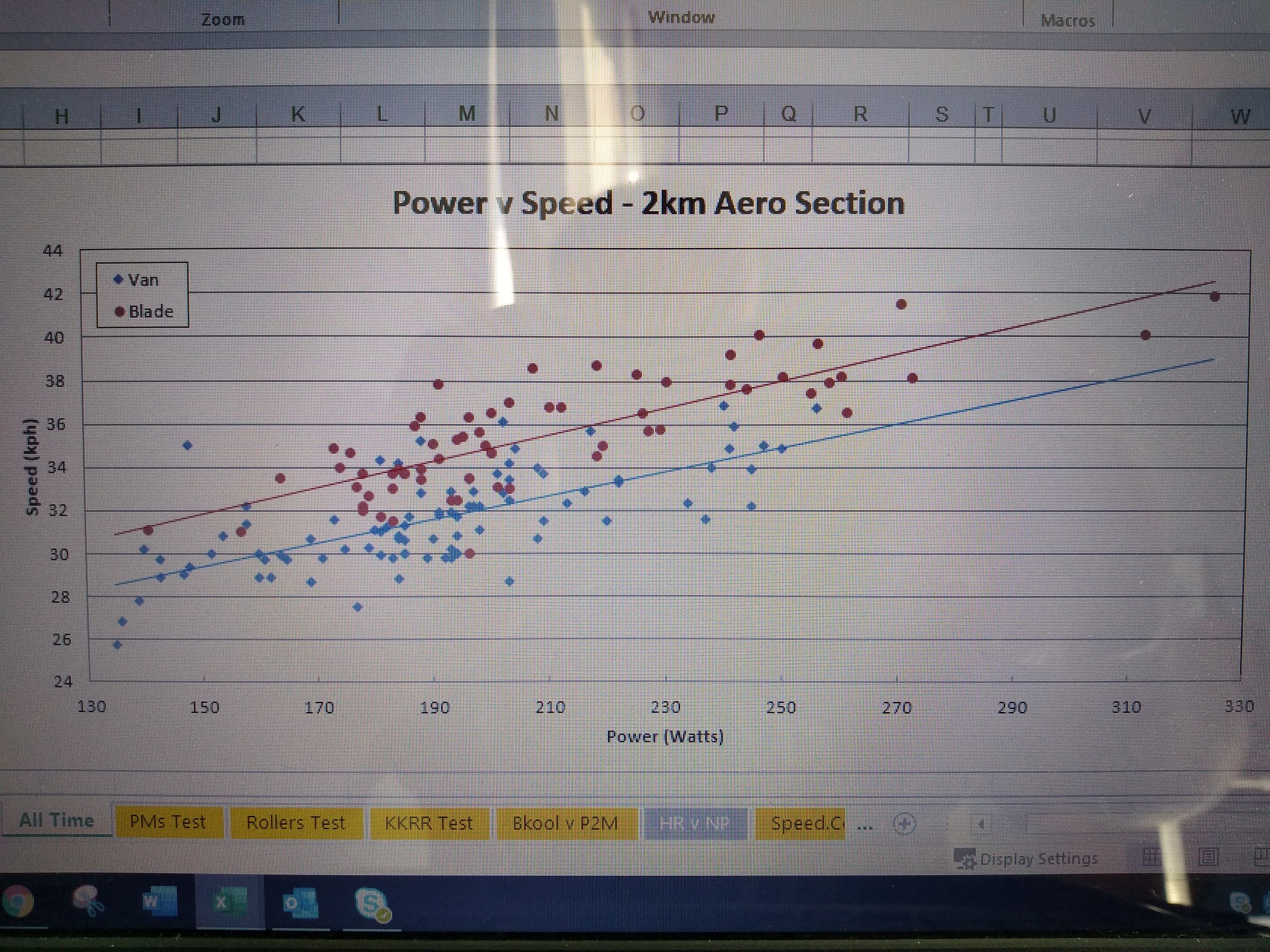
ETA - I apologise for having the axes the opposite way round, I’ll flog myself later.
ETA2 - I rememeber why I did it like that now. On the road you put out a certain power and the speed is the result. On the turbo, I rode at a certain speed (in practice each gear) and the power was the result.
1 Like
Ok so the first is showing 190w = 29km/h ish. As apposed to 24km/h on mine. 
I’ve just re-read your post and I’m not sure you can use the 190W vs 24kph as, if I’m reading it correctly, that’s an average over the whole interval session. The slope isn’t linear so I don’t think 10mins at 200W & 10mins at 100W would net the same rssult as 20mins at 150W.
The first graph I posted was done by holding each gear for a couple of minutes and taking the power/speed for that moment.
Your 260W seems a bit low though, that would be about 34kph for me (and about 35 on the road bike on my real world graph)
1 Like
Your right regarding the average yes. Didn’t have my maths head on so apologies for that.
Your graph points to 30kph for 200watts with was roughly what I was hoping/expecting.
1 Like
But surely by adding resistant on the roller you are simulating a gradient. 300W might equate to 40kph on a “flat” road resistance, but if you add enough resistance to simulate a 10% gradient then your speed might drop to 15kph for the same power.
The turbo is measuring the speed of the roller and therefore the speed of your back wheel. The trick is working out what your flat road resistance is to simulate the wind resistance on a flat road.
We’re talking about dumb trainers so there isn’t a way of adding resistance, resistance increases with speed on a fixed curve which, at least in my case, broadly simulates flat road speed/power.
(I believe that is the claim from KK too but it’s obviously variable according to many real world factors.)