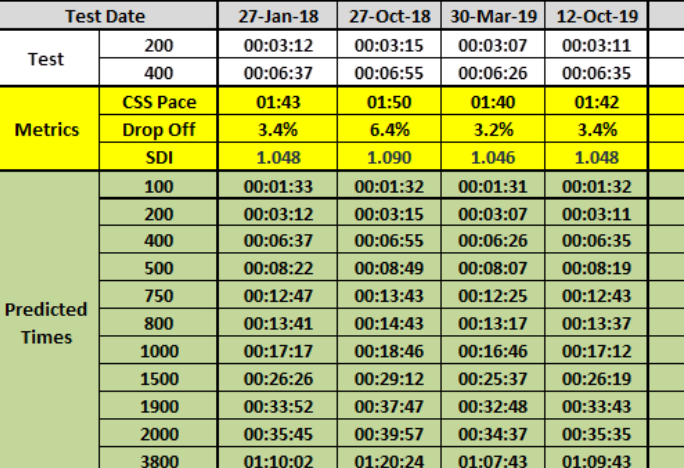
I wrote a little program to work it all out. I’ll share as Solar first got me onto this and its remarkably accurate. I believe it was a french guy developed the concept of SDI.
SDI = Log (T1/T2) / Log (D1/D2)
Where times are expressed in seconds, distances in meters
To predict a time
T1 * (DP/D1) ^ SDI
Where DP = Distance you wish to predict time for. so I’d typically use the 100 time as base here
The 1.06 average decay was based on a study by a guy called Pete Riegel
Can I just check my understanding of this? Are the times/distances your PB’s for those distances as when you perform a CSS test, the 200m is somewhat fatigued from the 400? Thanks
typically in swimming we would use pb’s, well recent fast times, but to be fair as long as conditions are reasonably similar it shouldn’t matter too much. If you look at Poets CSS times I recon there’s not much in it. it would be a few seconds at most either way.
this could be because of the times testing with are CSS test do maybe your 400 is a bit slower than it could have been or your pacing meant you held back a bit much or died a bit in last 100. Also was thw 1900 OW, so not quite 1900? Do a 100 flat out also in the pool. maybe use the 100 and your best 400 or even the 1900 to see what you get
I have a little java applet i wrote for it, typical developer should have just used excel! I have a second column with TFD times in and a 3rd column with difference in seconds
My 200 and 400m times from last week were both within 1s of yours… so I guess my CSS must be similar, around 1:42, I’ve not done a CSS test for 2 years, and it was 1:53 back then.
I also used the formula to create my own sheet, so looks like my estimated IM time is 1:10, so still need to work quite a bit to get that down lower
I know from your cycling and running performances that you’re way, way (and a few more ways) fitter than me so that would suggest to me that there’s still something technical to be found as you’re not seeing the benefit of that extra fitness in your swim.


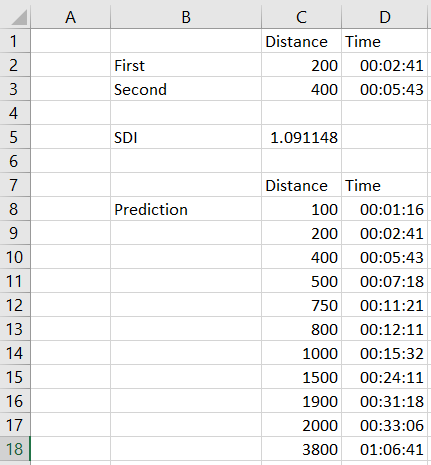

 (all PBs are non diving, start from the shallow end)