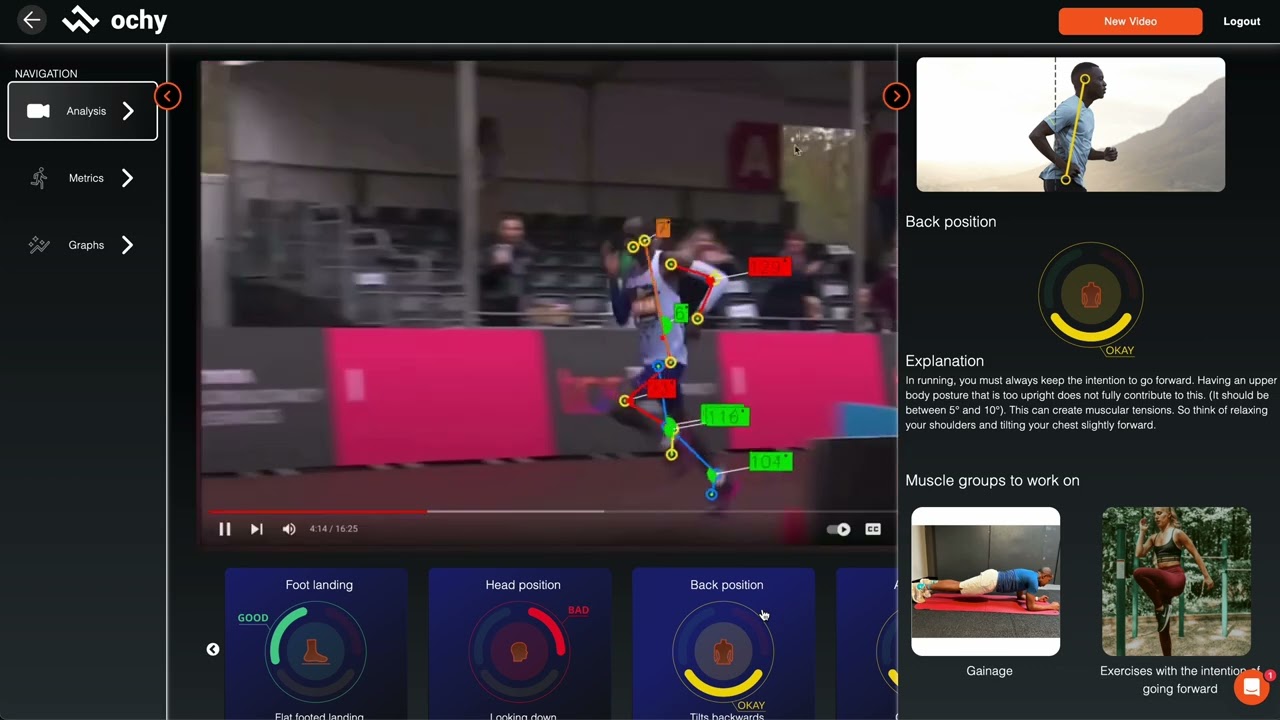
Ok, so then this sentence is confusing me:
Do you mean “at this stage of human knowledge of running form, this is…”?
Ok, so then this sentence is confusing me:
Do you mean “at this stage of human knowledge of running form, this is…”?
THIS meaning what was highlighted above…which is the basis of an idealistic representation - a model for - like swim smooth or pose running…
no…otherwise i would have written that…
The key word is similarities…what are you doing that Mo and opthers are doing at a high level….
such as?
So what I think of as counter is the whole need for easy runs. And the injury risk of too many hard sessions in a week.
At least for me, perhaps my weight plays into this, easy pace is so slow it’s hard to feel like you’re running with good form…without speeding up as a side effect. We’ve discussed this here before.
This leads me to want to train for shorter distances instead, so I don’t need to jog for hours.
some forwards, some upwards…
correct
But what else is happening in the 3 joints above?
Correct
Correct
correct
Yes
some of it
correct
also correct
i maent in what he said…all those years of high-performance and he didn’t question one of the key aspects that led to his injuries…
Focus on toe off - for now…
not viewed as yet - but he could be…if so, why?
would he be bouncy with forward force, or upward force?
less in more efficient runners…
what is a nice forward lean? as opposed to a nasty one?
two components to vertical oscillation…the second one is more critical and the first one can be mibnigated against - see images…
not necessarily…force is not necessarily related to cadence…but time is…
what makes a run ‘easy’ ?
Perceived effort. Or a significant number of helium balloons.
But the desired characteristics are; reduced impact, increased capillarisation, and gradually strengthening smaller supporting muscles and tissues.
does running slowly increase or decrease ground contact time?
Zone 2 then, not ‘easy’
Why not run 30 metres with good forrm, stop, recover and repeat…
I’m not sure how GCT describes impact? I would’ve thought that something like watts of the impact ( increasing with pace) would be the thing?
I think that the amplitude of the impact as well as the number of impacts, is what you’re trying to avoid.
So, like 90kg at 5:00/km would spike much higher than at 6:30. So like you can gently tap balsa wood for ever, but harder hits will eventually break it.
GTC doesn’t describe impact - impact transient does that, however, the greater GTC, the greater chance of knee flexion leading to greater deceleration of COM leading to greater ground forces…
reduce the impact then…
Is there any other way than reducing speed?
Kelvin Keptum in the finishing straight of the London Marathon
Not the same but does Colin Jackson count for something?
Looks like he has lazy arms these days too…
Years ago, there was an Aussie pro triathlete called Jason Shortis, he was a much quicker runner than his size would suggest.
I remember an interview with him. He said even in a race, that he concentrated on holding his form for ten steps, then reset and counted the next ten and so on.
In training he used to stop after ten and then would not run again until he could do the next ten. Then over time, he would string them together but still counted every ten.
I don’t even know why I remember that. 
When I had my calf issues the physio told me to do this, said start at 30sec, run with lighter feet, don’t plod increase cadence and slowly build up time running. So many other issues got in way after, but it did work. I focused on cadence around 180, not plodding at 150 or so, and 30min with 20 of 1 on/1 off was about same distance as a 30 min plod and felt less battered after also
One thing about good runners, One year at Southern XC at PH it was knee deep mud, every footstep I sunk and the energy cost, 15k left me feeling like I’d raced 20miles. I was lapped (3 * 5k) by the top 10, they ran 45mins or so, but they looked like they were floating on the mud, due to lightness/speed of their feet
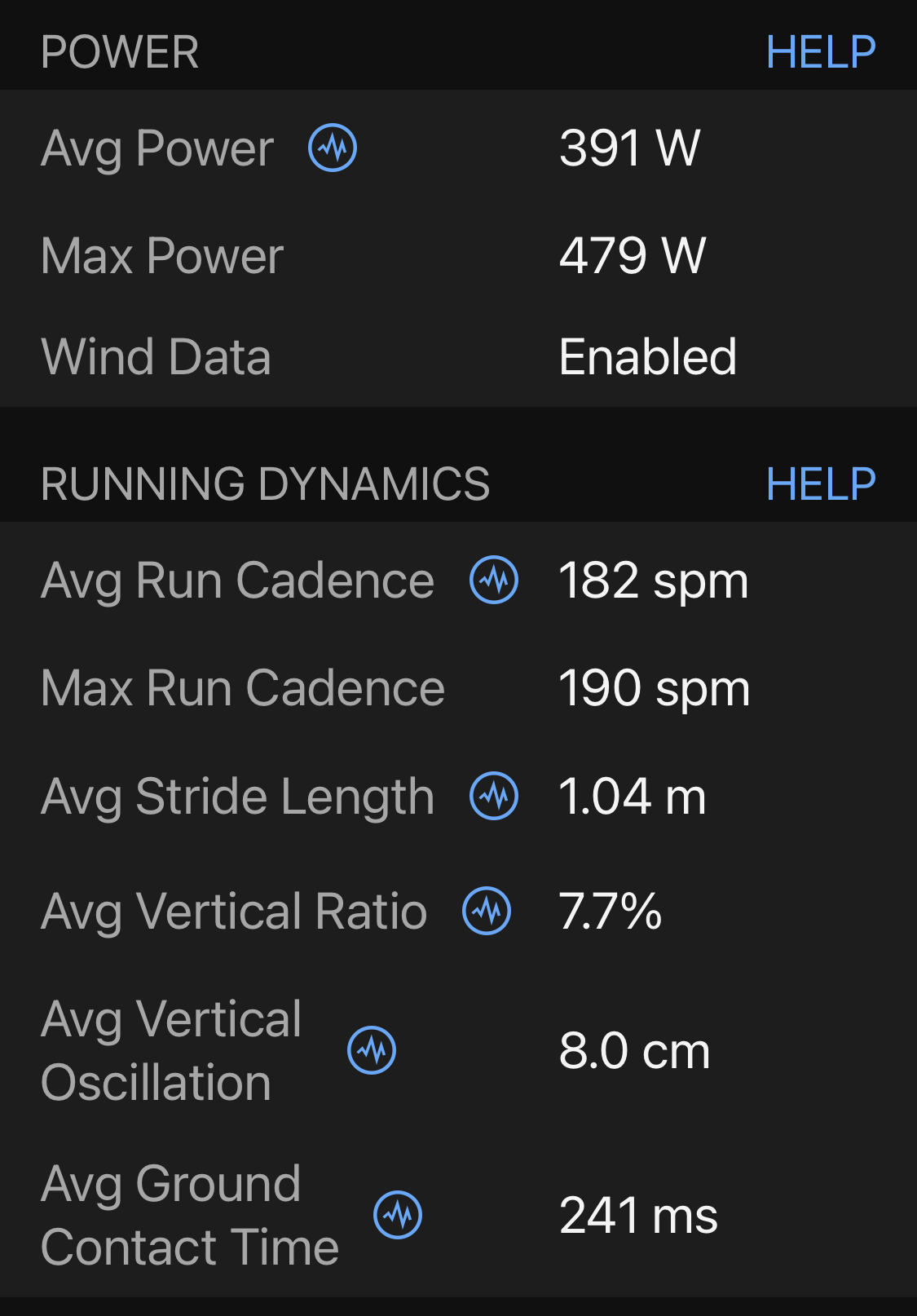
Don’t think I ever drop below 170 cadence, I’m pretty solid around 180. Here was today’s 5k best effort.
Where it says:
RUNNING Dynamics. HELP. Is this a recommendation?

So what is good in there and what needs addressing and what do we not know enough about to address at the moment?
it does…
I’m unclear. The HELP generally tells me that my stats are in the ok/good range but not in the excellent space.
If I look at stride length, vertical oscillation, ground contact time, well they all correlate strongly to pace - so these can all improve if I run at 4:30 instead of 5:10/km.
8cm vertical oscillation doesn’t seem a huge amount to me, if there’s a way to reduce this without running faster, or to run faster for less effort …?